




Mastering Your Wedding Day Timeline
I’ve photographed hundreds of weddings. Within the first 30 minutes of looking at a DIY timeline, I know whether the couple’s day will feel rushed, stressed, or like they’re checking boxes.
The problem isn’t couples not caring about their timeline. They’re planning for logistics when they should be planning for emotion.
Let me explain.
The 10-Minute Myth That Derails Everything
A couple sits down to create their timeline. They write: “Bride gets in dress: 10 minutes.”
Technically, yes. You zip a dress in 10 minutes.
But not what happens.
Getting into the dress means stepping into it carefully so you don’t mess up your hair. Fastening jewelry. Adjusting the veil. Making sure your shoes are on. And what no one accounts for: the moment with your mother.
She’s helping you into your dress. You’re both tearing up. You exchange a gift. You hug. This isn’t something you schedule or rush. It happens.
If you budgeted only 10 minutes, you’ve already lost 20. The cascade has started.
One wedding photographer documented a bride who didn’t realize how difficult getting into her dress would be with hair and veil already in place. Required teamwork. Caused delays. The timeline fell apart before the ceremony even started.
This is the fundamental flaw in DIY wedding timelines: couples plan for the task, not the moment.
What You’re Missing
When I review a couple’s DIY timeline, I spot immediately what they don’t understand about how their wedding day will feel.
They don’t understand how long things take.
If you have a wedding party with 15 people, moving them from point A to point B takes longer. If you want flat lay detail photos, arranging and photographing them requires time. If your mother prioritizes visiting with friends over staying on schedule, you need buffer time.
Research shows 80% of couples admit to making at least one major planning mistake during their wedding preparations. Timeline troubles consistently rank among the most common issues.
This isn’t about priorities being off. This is lack of knowledge about how a real-world wedding day works.
You won’t feel like going A, B, C, D, E, F, G straight through a list. You’ll want time to enjoy the day. Time where it doesn’t feel rushed.
The Timeline Is a Container for Authentic Moments
I think about timelines differently.
I don’t schedule every hug, every tear, every spontaneous moment. I create containers where those moments happen naturally.
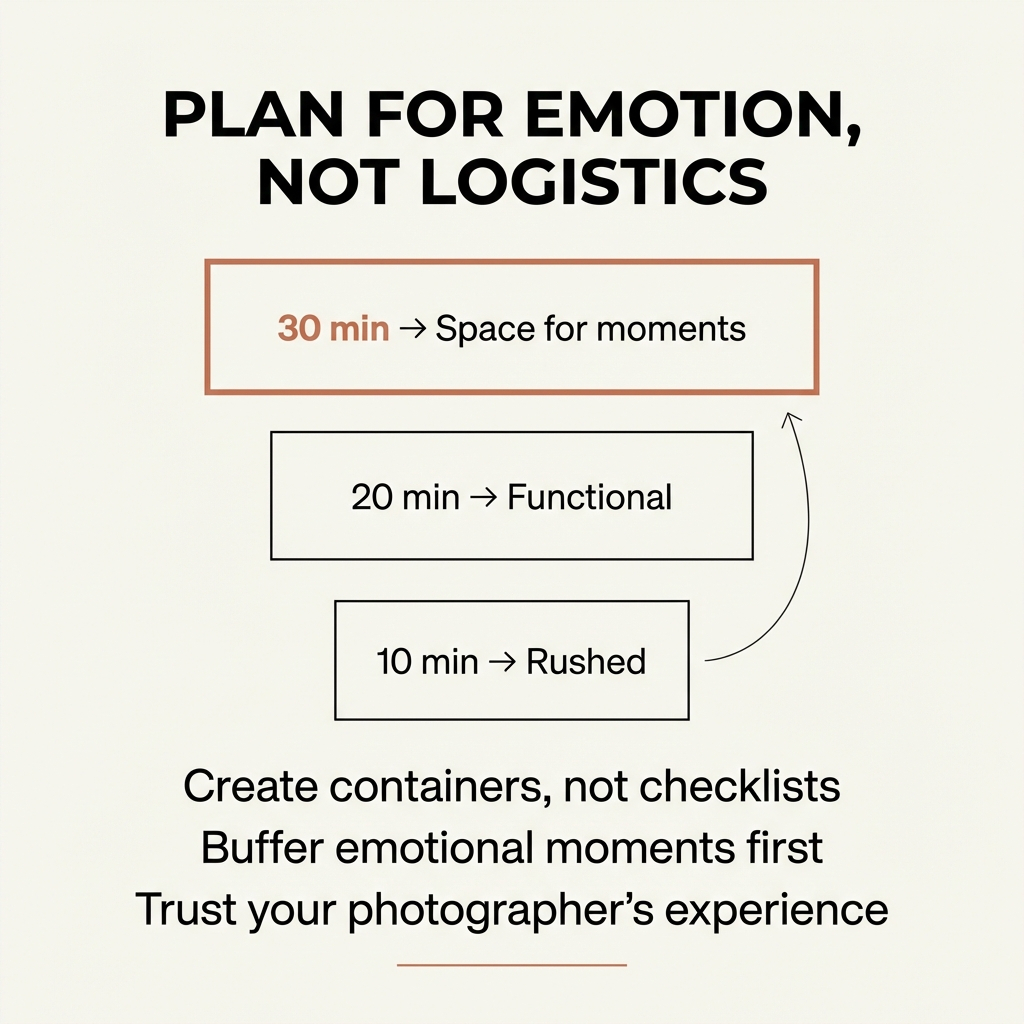
When I write “Bride steps into dress: 30 minutes,” I know zipping the dress probably takes only 10 minutes. But I want to allow plenty of time for things to happen organically. The moment with mom. The jewelry mishap. The last-minute veil adjustment.
If I put only 10 minutes on the timeline, there’s no time for the authentic to happen. No time for emotion or feeling. Only time to finish and complete each task.
I don’t want a wedding day structured like this.
Where to Build Buffer Time (and Where Not To)
I don’t buffer everything equally.
Certain moments need more breathing room than others.
First look is a perfect example. The moment of seeing each other takes five minutes. But I want time buffered in for the bride and groom to have an intimate moment by themselves. Not the reveal alone, but the quiet minutes after.
Professional wedding photographers who’ve built buffers into hundreds of timelines report since they started encouraging couples to use these buffers, they rarely have a wedding schedule run late. They recommend two 30-minute buffers: one right after getting ready and one before the ceremony.
Family photos and wedding party photos get less buffer time. Those are more posed, more direct. “Mom and dad stand here. Now add brother and sister.” It’s formal, less documentary. The biggest reason to buffer here is allowing for people who run late.
When timelines get tight and I have to choose what gets cut or compressed, I protect bride and groom time first and foremost.
You are the most important part of the day. Your photos are the most important part of the day. I’ll shave time from wedding party and family photos before I touch your couple portraits.
The Math Working
When I sit down to create a timeline from scratch, my foundational approach:
I take the ceremony time and the total photography coverage you’ve booked. Then I split it: half pre-ceremony, half ceremony and reception.
This ensures even coverage. Photos aren’t too heavy on the front end. The reception doesn’t feel under-documented. Time distributes evenly across the day.
From there, I fill in all the blocks. But I make sure there’s enough time on the front end. A lot of people don’t allow enough time before the ceremony for things to flow naturally.
If you give me only two hours before the ceremony instead of four, what disappears: detail photos, bride and bridesmaid portraits, bride and family portraits, groom and groomsmen portraits, groom and family portraits.
Without front-end time, you’re going to feel portrait-heavy and exhausted after the ceremony. You’ll be trying to get all the photos done in one block of time instead of spreading it out across the day.
Most wedding photographers say you need at least 30 minutes for wedding party portraits, 30 minutes for family portraits, and 45 minutes for couple portraits—totaling about two hours of portrait time minimum.
Who Owns the Timeline
Things get complicated here.
The planner is the number one person responsible for the flow of the day. But the photographer should have a strong voice in the photo side of the timeline and the structure of the day. So much of the timeline reflects in photography.
Everyone has to agree to be on the same page and work through issues that arise.
If there’s a conflict about not having enough coverage or not wanting to allow enough time for certain things, communicate on the front end. Then communicate with the bride.
Ultimately, your day. If you want to structure it differently than I recommend, I’ll allow it to happen. But not without some proceed-with-caution warnings.
When couples don’t heed those warnings, it shows in the photos. It shows in the way the day feels overall.
The last thing I want is for your wedding day to feel stressed or rushed or like we’re going through the motions from point A to point B. I want there to be time for it to flow easily and organically.
What Happens When You Ignore the Warnings
I’ve had couples who didn’t listen.
The photos we got would have been so much better with the right timing and the right things set aside in the timeline.
With hundreds of weddings under my belt, I know what it takes to pull off an amazing wedding with amazing photos. One of the things: time.
If you don’t heed the warning, it shows. Not in the photos alone, but in how the entire day feels.
Real wedding disasters prove this point. One Chicago luxury wedding planner documented how a bride and her party ended up over 30 minutes from the venue due to transportation mistakes. Because they’d built a 45-minute cushion into the timeline, they recovered by shortening cocktail hour and tightening the ceremony.
Without that buffer? Total chaos.
The Timeline Working
I’ve photographed timelines working almost perfectly. Where we stayed on schedule and nothing felt rushed.
What those couples did differently.
They valued photography. They had plenty of photography coverage. So I didn’t have to pick and choose what was more important. Everything was important, and we were able to document the entire day.
They allowed plenty of time for details. They created margin in their timeline so things didn’t feel rushed.
They allowed time to have portraits made in more than one location.
They communicated the timeline to everyone involved. People showed up when they were supposed to show up. All the vendors were on the same page. Everything was sent out before the wedding day. Nothing was caught off guard.
There was nothing that went uncovered because of lack of time.
The One Thing You Need to Understand
One piece of advice about creating your wedding timeline:
Trust your photographer and planner, and take their advice.
You don’t have to figure out everything on your own. Your photographer and planner have lots of experience. If they have a recommendation, trust it. Value the people you hired to document your day and plan your day accordingly.
This is something we do all the time. Your wedding is probably your only wedding when it comes to the planning side of things.
We’ve seen what works. We’ve seen what falls apart. We know the difference between a timeline looking good on paper and a timeline functioning when emotion, family dynamics, and unexpected moments enter the picture.
The timeline isn’t about timing. It’s about creating space for your wedding day to feel like your wedding day, not a checklist you’re racing through.
Plan for logistics. But more importantly, plan for emotion.
That’s the difference between a timeline that falls apart and one that holds everything together.
You may also like
what I'm learning, encouragement, scripture reflections
family, faith, routines, what I’m loving lately
tips for brides, resources for creatives
dreamy galleries, real love stories, details & joy
What you’ll find around here
tips for brides, resources for creatives


Shop My Favorites
A little corner of the internet where I get to share the things I’m currently loving—whether that’s a cozy outfit, a good book, something cute for your home, or a go-to gift idea. These are the finds I actually use, wear, read, and enjoy. It’s a mix of my style, my season of life, and what’s bringing joy lately.
Jennie's Picks

Kickstart Your Entrepreneurial Journey with My Comprehensive Guide to Starting your Own Business
Roadmap to Start
Your business
